What to Check Before Switching From Cool to Heat
Central Florida runs in cooling mode for most of the year, so the first cool front of the season is often the first time the heating side of your system has been asked to do anything in eight or nine months. That long gap matters more than most homeowners expect, because components that sit idle through a hot, humid summer do not always wake up cleanly. A reversing valve can stick, electric heat strips collect a season of dust, and a thermostat programmed around summer setpoints may have never received a single heating call. Homeowners in Winter Garden, Windermere, and Clermont tend to discover all of this on the first genuinely cold night, which is the same night every other homeowner in the county is discovering it and calling for service. Running through a short list of checks in September or October gives you the chance to find these problems while the weather is still mild and scheduling is still easy. This guide covers what to inspect inside the house, what to look at around the equipment itself, and where the line sits between a homeowner task and work that belongs to a licensed technician.
What to Check Before Switching From Cool to Heat Inside Your Home
Most of the useful checks happen indoors, and none of them require tools or technical training. The thermostat, the filter, the return grille, and your own ears and nose will tell you a great deal about how the heating side is going to behave. The goal is not to diagnose the system yourself; the goal is to run heat on a mild day so that any problem shows up on your schedule instead of during a cold snap. Give yourself thirty minutes for the whole process and pay attention to what changes once the system starts. Anything that seems wrong at this stage is far cheaper and far easier to correct in early fall than it will be in January.
Thermostat Settings to Check Before Switching From Cool to Heat
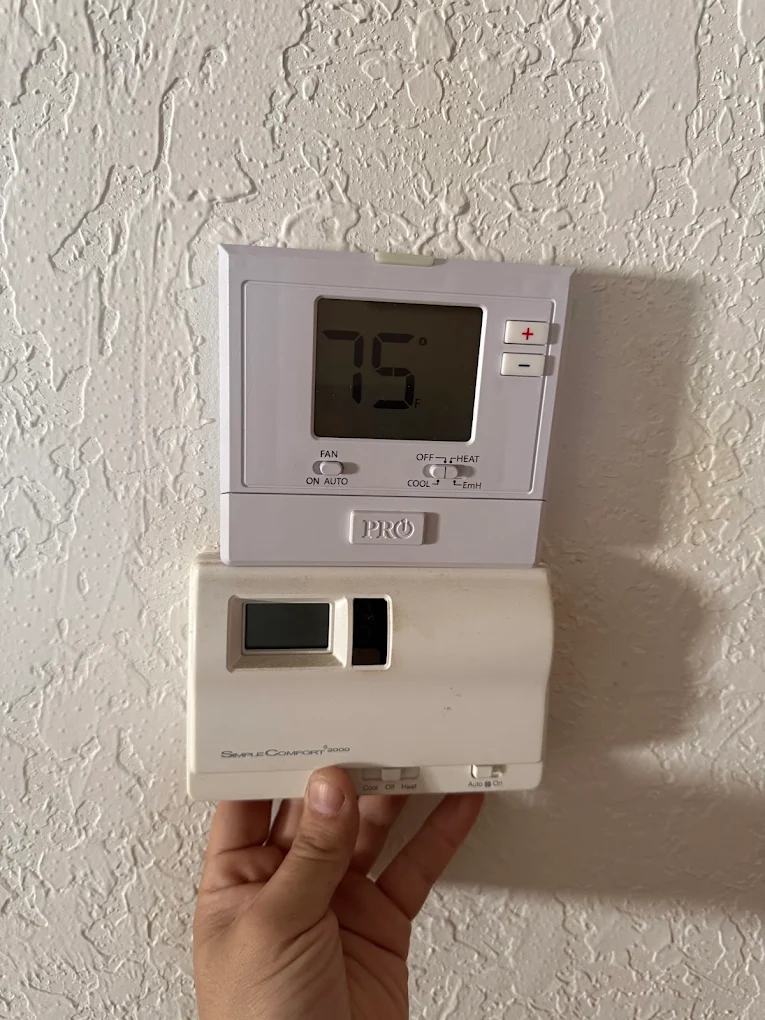
Start with the simplest possibility, which is power. Battery powered thermostats often fail in the shoulder seasons because the batteries have been slowly draining all summer while the display looked perfectly normal, and a weak battery can cause a thermostat to lose its connection to the equipment without ever going blank. Replace them before you do anything else, then move the system mode from cool to heat and raise the setpoint at least three degrees above the current room temperature so the thermostat has a real reason to make a call. Many systems include a compressor time delay of about five minutes, so nothing will happen immediately and that silence is not a malfunction. Wait the full delay before deciding something is wrong. If you have a smart or programmable thermostat, open the equipment settings and confirm it is configured for the type of system you actually own, since a thermostat set up for a conventional gas furnace will not control a heat pump correctly no matter how new it is.
Next, look at the difference between auxiliary heat and emergency heat, because these two terms confuse almost everyone and the confusion is expensive. On a heat pump, auxiliary heat is the electric strip heat that comes on automatically to help the compressor when the outdoor temperature drops or when the indoor temperature falls far below the setpoint. Emergency heat is different; it locks the compressor out entirely and runs those electric strips alone, which costs substantially more per hour to operate and should only be used when the compressor or the outdoor unit is genuinely out of service. Homeowners sometimes flip to emergency heat in October because the air felt cool at the register, then wonder why the November power bill doubled. Leave the thermostat in normal heat mode and let the system decide when it needs help. If you find that emergency heat was already selected from last winter and nobody turned it off, that alone is worth fixing today.
Finally, revisit your schedule and your setbacks, since summer programming rarely translates well to heating season. Heat pumps are most efficient when they run long and steady, so a deep overnight setback followed by a large morning recovery will simply trigger the electric strips and erase whatever savings you were hoping to capture. A setback of two to three degrees is the practical ceiling for most heat pump systems in Central Florida. Also confirm the thermostat is not stuck on a permanent hold from last spring, which quietly overrides every schedule you have built. Walk through each programmed period and make sure the heating setpoints make sense for how your household actually lives. Is your thermostat behaving strangely or showing settings you did not choose? Click here for our thermostat services.
Air Filters and Vents to Check Before Switching From Cool to Heat
A dirty filter causes more heating complaints than almost any mechanical failure, and after a full Florida cooling season the filter in your return is almost certainly overdue. Standard one inch filters need replacement every thirty to ninety days depending on pets, dust, and how many hours the system ran, and a summer of near constant operation pushes most homes toward the short end of that range. Media filters that sit four or five inches deep in a cabinet typically last six to twelve months, but they still deserve a look before heating season begins. When you install the new filter, check the airflow arrow printed on the frame and point it toward the equipment, since a backward filter loses efficiency and can collapse against the rack. Write the date on the frame with a marker so the next replacement is not a guessing game. Restricted airflow raises static pressure across the whole system, and on the heating side that translates into short cycling, overheated components, and premature failure.
Return grilles matter just as much as the filter itself, though they rarely get any attention. Walk the house and confirm nothing is leaning against a return, since furniture, laundry baskets, and curtains all block air the system needs to pull back. A return that cannot breathe starves the blower no matter how clean the filter is. Do the same walk for your supply registers and open every one of them, including the registers in guest rooms and offices you rarely use. Closing vents to save money is one of the most persistent myths in home comfort, and it does the opposite by forcing the blower to work against a smaller opening. If your home has floor registers, look inside for the toys, coins, and pet hair that accumulate all year.
Once air is moving freely, pay attention to how the house responds during the first heating run. Rooms that were already uneven in summer will usually be uneven in winter, and the pattern tells you something useful about the duct system. A back bedroom that stays four or five degrees colder than the thermostat location often points to a duct leak, a crushed flex run, or a supply that was undersized when the house was built. Note which rooms lag and how far behind they fall, because that information saves diagnostic time later. Also watch how long the system runs to satisfy a call, since unusually short cycles frequently trace back to airflow rather than to the heating source itself. Bring these observations to your technician instead of trying to solve them with vent adjustments.
Sounds and Smells to Check Before Switching From Cool to Heat
The first heating run of the season almost always produces a burning smell, and in most cases it is completely normal. Dust settles on electric heat strips and on furnace heat exchangers over months of disuse, and when those surfaces heat up for the first time that dust burns off. The odor should be faint, should not smell like plastic or rubber, and should fade within twenty to thirty minutes of runtime. Open a window or two during that first cycle and let the house clear. What is not normal is a burning smell that persists past that first hour, gets stronger over time, or smells sharp and chemical rather than dusty. Shut the system off and call for service if that happens, because a smell like hot plastic can indicate an overheating motor or damaged wiring.
Sounds deserve the same attention. A heat pump makes a distinct whooshing or shuddering noise when the reversing valve shifts the refrigerant flow from cooling to heating, and that sound is expected and harmless. Rattling from the ductwork usually points to loose sheet metal or a register that needs a screw tightened. Whistling almost always means restricted return air, which sends you back to the filter and the return grille. Metallic scraping, repeated clicking without a start, or a hum that never resolves into the blower actually running are all reasons to stop and make a call. Grinding from an outdoor unit in particular should never be ignored, since it usually involves a failing motor bearing or a fan blade contacting something it should not.
Gas equipment adds one more category, and it is the one that carries real safety weight. Any smell of rotten eggs or sulfur near a furnace means you leave the house first and call the gas utility from outside, not from inside. Carbon monoxide has no smell at all, which is exactly why every home with fuel burning equipment needs working carbon monoxide detectors on each level and near sleeping areas. Test those detectors during the same visit you change your filter and replace batteries on any unit more than seven years old, since the sensors themselves expire. Soot around the furnace cabinet, a yellow or flickering burner flame instead of a steady blue one, or visible rust on the vent pipe all warrant an immediate professional inspection. Hearing noises you cannot explain from your heating equipment? Click here for our furnace services.
What to Check Before Switching From Cool to Heat Outside and at the Equipment
Once the indoor checks are done, the equipment itself deserves a look. In Central Florida the majority of homes run heat pumps, meaning the same outdoor unit that cooled your house all summer is now responsible for heating it, and it needs to be in good condition to do that job. Other homes use an electric air handler with resistance heat strips, and a smaller number use gas furnaces. Each of these has its own short list of seasonal concerns. You can safely handle the visual and housekeeping items yourself, but anything involving panels, refrigerant, gas, or line voltage belongs to a licensed technician.
The Outdoor Heat Pump Check Before Switching From Cool to Heat
Your outdoor unit works harder in heating mode than most homeowners realize, because it is pulling heat out of cool outdoor air and moving it inside. That process requires unrestricted airflow across the outdoor coil, so start by clearing everything within about two feet of the cabinet on all sides and leaving several feet of open space above it. Trim back shrubs that grew over the summer, rake out the leaves and pine needles that collect against the base, and move anything you stored next to the unit when the yard got busy. Rinse the coil gently with a garden hose from the inside out if it looks matted with debris, using normal water pressure rather than a pressure washer. Confirm the disconnect box on the wall is still in the on position, since it sometimes gets pulled during landscaping or exterior work. A unit that is starved for air will underperform in heating and will run up your bill trying to keep up.
Resist the urge to cover the outdoor unit for the season. Heat pumps run year round in this climate, and a full cover traps moisture, invites pests, and can block the fan if the system starts while it is wrapped. If you want to protect the top from falling debris, a simple board or an approved top cover that leaves the sides open is acceptable, but nothing should ever enclose the cabinet. Check that the equipment pad is still reasonably level, since settling soil can tilt a unit over time and stress the refrigerant lines. Look at the insulation on the larger copper line running to the house and replace it if it has cracked or crumbled from sun exposure. Small items like this cost very little and protect efficiency all season.
Understanding normal heat pump behavior will also save you an unnecessary service call. Air coming out of your supply registers in heat pump mode typically measures somewhere around eighty five to ninety five degrees, which is warm but still cooler than your skin temperature, so it can feel lukewarm to the hand. That sensation is expected and does not mean the system is broken. You may also see the outdoor unit produce steam or run a cycle where the fan stops and the unit sounds different for several minutes; that is defrost, and it is the system melting frost off the outdoor coil before returning to normal operation. What is not normal is a heat pump that runs constantly without gaining temperature, ice that never melts, or a compressor that never engages at all. Need your heat pump checked before the first cold front? Click here for our heat pump services.

The Furnace and Heat Strip Safety Check Before Switching From Cool to Heat
Homes with electric resistance heat strips inside the air handler have a straightforward but important set of concerns. Those strips draw significant amperage, often in the range of five to twenty kilowatts, and the sequencers, contactors, and wiring that feed them see real thermal stress every time they engage. A technician checks amperage draw against the nameplate rating, inspects the limit switches that shut strips down if airflow fails, and verifies that the breaker feeding the air handler is correctly sized and free of heat damage. Homeowners should not open the air handler cabinet to look at any of this. What you can do is note if the breaker has tripped before, if lights dim noticeably when heat engages, or if you smell hot metal near the closet or attic. Those symptoms belong in a phone call, not a repair attempt.
Gas furnaces carry a longer list because combustion introduces safety considerations that electric heat does not. The heat exchanger separates combustion gases from the air you breathe, and a crack in that component allows carbon monoxide into the living space, which is the single most serious failure in residential heating. Technicians inspect that surface visually and with instruments, verify the flue is clear and properly pitched, and confirm the burner assembly is clean and lighting reliably. Combustion air matters too, so nothing should be stored around the furnace, particularly paint, gasoline, cleaning chemicals, or cardboard. The gas shutoff valve should be accessible and the vent connections should show no rust, gaps, or disconnected sections. None of this is a homeowner task, and no online video makes it one.
There is also a timing argument that has nothing to do with mechanics. Heating equipment fails on the coldest days because that is when it is under maximum load, and that is exactly when service demand spikes across the region. A furnace or air handler inspected in September gets full attention, easy parts availability, and a normal appointment window. The same inspection requested during the first hard freeze competes with dozens of no heat calls. Scheduling early is not upselling; it is the practical difference between a planned repair and an emergency one. Homeowners who make the fall inspection a habit rarely deal with midwinter surprises.
Ductwork and Airflow to Check Before Switching From Cool to Heat
Ductwork determines how much of the heat your equipment produces actually reaches your rooms, and in Florida homes most of that ductwork sits in a hot, humid attic where it takes a beating. Flex duct sags, insulation compresses, and connections at boots and plenums loosen over the years. Leaks that dumped cold air into the attic all summer will dump warm air into that same attic all winter. If you have safe attic access, look for obvious problems from a walkway: a disconnected run lying on the insulation, a boot that has pulled away from a ceiling register, or crushed sections pinched under stored boxes. Do not crawl across joists or handle duct repairs yourself. Report what you see and let a technician evaluate the system as a whole.
Sealing and insulation upgrades tend to pay for themselves faster than most homeowners expect. A duct system with meaningful leakage can waste a substantial share of the conditioned air it carries, and that loss shows up on every utility bill for as long as the leak exists. Proper repair uses mastic or approved foil backed tape rather than the cloth duct tape sold in hardware stores, which dries out and fails within a few years. Insulation levels also matter in attics that swing from very hot to genuinely cool over the course of a year. A technician can measure static pressure and airflow to quantify the problem rather than guess at it. That data turns a vague complaint about uneven rooms into a specific, fixable list.
Duct condition affects air quality as much as comfort. Leaky return sections pull attic air, dust, insulation fibers, and humidity directly into the airstream and distribute it through the house. If anyone in the home deals with allergies or asthma, that pathway is worth closing. Musty odors that appear when the system starts, visible dust streaking around register faces, and rooms that stay dusty no matter how often you clean all point toward the duct system. Addressing it before heating season means you spend the cooler months breathing better air. Noticing uneven rooms or dust around your registers? Click here for our air duct services.
Why You Need a Professional Check Before Switching From Cool to Heat
Homeowner checks catch the obvious problems, and they are worth doing every year. What they cannot catch are the measurements that predict failure: amperage draw creeping upward, refrigerant charge slightly off, a capacitor reading below tolerance, static pressure high enough to shorten a blower motor’s life. Those findings come from instruments and from technicians who know what the numbers should look like on your specific equipment. A fall inspection catches small deviations while they are still inexpensive to correct. It also gives you an honest picture of where your system stands, which matters most on equipment past the ten year mark.
What a Professional Check Before Switching From Cool to Heat Includes
A thorough heating inspection covers the electrical, mechanical, and airflow sides of the system rather than just confirming that warm air comes out. Technicians test capacitors and contactors, measure voltage and amperage under load, and verify that safety controls actually function instead of assuming they will. On a heat pump, that includes confirming the reversing valve shifts correctly and that the defrost board and sensors are doing their job. Refrigerant charge gets verified against manufacturer specifications, because a system that limped through summer slightly low will struggle far more in heating mode. Each of these steps produces a number that either falls in range or does not.
The airflow portion is equally important and often skipped by cheaper inspections. Measuring static pressure reveals restrictions that no visual check will show, and comparing supply and return temperatures confirms the system is delivering the output it was designed to deliver. Blower wheels collect a surprising amount of buildup over a Florida summer, and a loaded wheel moves noticeably less air than a clean one. Technicians also verify that the condensate drain is clear, since a clogged drain can trip a safety switch and shut the whole system down. These checks protect both comfort and equipment life.
Finally, a good inspection ends with clear communication rather than a sales pitch. You should learn what was tested, what the readings were, what looks healthy, and what is trending toward a problem. Items that need attention should come with a straightforward explanation and an honest price. Items that can wait should be identified as such, with a realistic timeline. That transparency is the entire point of having the work done by professionals you trust.
When to Call for Help Before Switching From Cool to Heat
Certain symptoms should send you straight to the phone instead of through another round of homeowner troubleshooting. A system that will not start at all after you have confirmed thermostat power, breaker position, and the compressor time delay needs a technician. Repeated breaker trips are a warning about an electrical fault and should never be handled by simply resetting the breaker again. Burning smells that persist past the first cycle, grinding or metallic noises, and any smell of gas near fuel burning equipment all fall into the same category.
Performance problems deserve a call as well, even when nothing sounds broken. A heat pump that runs continuously without reaching the setpoint, ice on the outdoor unit that never clears, or a sudden jump in your electric bill without a matching change in weather all indicate something is wrong internally. Rooms that were comfortable last winter and are not comfortable this year point to a change in the system, not a change in your tolerance. Waiting rarely improves any of these situations, and small failures cascade into larger ones.
Age changes the calculation too. Systems in the twelve to fifteen year range should be evaluated with replacement timing in mind, not because every older unit needs replacing but because you deserve to plan rather than react. An honest technician will tell you when repair still makes financial sense and when it does not. That conversation is far better held in October than during a December failure. Want your cooling system evaluated at the same visit? Click here for our air conditioning services.
Why Choose Legion Cooling for Your Check Before Switching From Cool to Heat
Legion Cooling is a family owned, faith driven company serving Winter Garden and the surrounding Central Florida communities from 1334 Winter Green Way. We built this business on honest expert service, which means our technicians explain what they find, show you the readings behind the recommendation, and never sell you equipment you do not need. Straightforward quotes with no hidden fees is not a slogan for us; it is how every job gets priced. We are fully licensed and insured, and financing is available for larger repairs and replacements.
Our team works throughout Winter Garden, Windermere, Horizon West, Clermont, Ocoee, Apopka, Dr. Phillips, Celebration, Kissimmee, Winter Park, and the surrounding areas. Because we live and work here, we understand how Central Florida systems actually behave: long cooling seasons, short heating demands, attic ductwork, and heat pumps that carry the load year round. That local knowledge shapes how we inspect and what we look for. It also means we are close by when you need us.
Getting your heating side checked before the first cold front is one of the least expensive things you can do for your system all year. Call us at (321) 316-2422 or email info@legioncooling.com to schedule your seasonal inspection. We are committed to getting it done right every time, and we would be glad to earn your trust this season.