
Why Your Vents Are Covered in Dust and How to Stop It
Dust on your supply registers is one of the most common complaints homeowners bring to us, and it almost never means you are a bad housekeeper. In Central Florida, your air conditioner runs close to nine months out of the year, which means the air in your home cycles through the ductwork thousands of times every season. Every one of those cycles is an opportunity for particles to settle on the grille, the vent louvers, and the ceiling around them. When you see a gray film building up faster than you can wipe it away, the system is telling you something about how it pulls air, how it filters air, and how well the ducts are sealed. The dust you see on the vent is only the visible portion of a much larger amount that is circulating through your living space. Homes in Winter Garden, Windermere, and Horizon West deal with fine sand, construction dust from new development, pollen, and attic insulation fibers, and all of it finds a way into a leaky duct system. The good news is that dusty vents are a solvable problem with clear causes, and most of those causes are correctable in a single service visit. This guide walks through why your vents are covered in dust, what is actually producing it, and the specific steps that stop it from coming back.
Why Your Vents Are Covered in Dust in the First Place
Your air handler is essentially a large vacuum that moves several hundred cubic feet of air per minute through a closed loop of metal and flex duct. Anything that gets pulled into that loop either lands on the filter, sticks to the inside of the duct wall, settles on the blower wheel, or comes out through a supply register and lands on the grille. A properly built system pulls all of its return air from inside the conditioned living space and delivers all of it back through sealed supply runs. Real houses rarely work that cleanly, especially older ones and homes where the duct system has been modified over the years. Once outside air, attic air, or wall cavity air enters the loop, the amount of particulate moving through the system climbs sharply. The three biggest contributors we find in Central Florida homes are filtration failures, duct leakage, and humidity combined with everyday household activity.
Air Filter Problems That Leave Your Vents Covered in Dust
The filter is the first thing to check, but the problem is usually not that a homeowner forgot to change it. The more common issue is filter bypass, which happens when air sneaks around the edges of the filter instead of passing through the media. A one inch filter sitting loosely in an oversized slot, a filter grille with a bent frame, or a missing filter door on the air handler will all let unfiltered air move straight into the blower compartment. That bypassed air carries everything the filter was supposed to catch, and it deposits that material on the blower wheel, the evaporator coil, and eventually the inside surface of every supply duct. From there it works its way out to your registers a little at a time, which is why the dust seems to reappear within days of cleaning. A filter that fits tightly and sits flush against the frame on all four sides eliminates a surprising percentage of the problem by itself.
Filter rating also matters more than most people realize. A cheap fiberglass panel filter rated MERV 1 to 4 is designed to protect the equipment, not the air you breathe, and it allows most fine particulate to pass right through. Stepping up to a pleated filter in the MERV 8 to 11 range captures a much wider range of dust, pollen, and dander without creating unreasonable airflow restriction in a typical residential system. Going too far in the other direction causes its own trouble, since a MERV 13 or higher filter installed in a system that was not designed for the added pressure drop will starve the blower for air. Restricted airflow raises static pressure, reduces cooling capacity, and can cause the filter media to flex and pull away from its frame, which reintroduces the same bypass problem you were trying to solve. The correct filter is the one that balances particle capture against the static pressure your specific equipment can handle.
Change intervals in Florida also run shorter than the packaging suggests. A one inch pleated filter in a home with pets, children, or nearby construction often needs replacement every 30 to 45 days rather than the 90 days printed on the box. A four inch or five inch media cabinet holds far more surface area, runs at a lower pressure drop, and typically lasts six to twelve months, which makes it a better long term choice for dust control. If you are pulling out a filter that is gray and matted before the month is over, that is evidence of a much larger particle load entering the system, not just proof that the filter is doing its job. At that point, replacing the filter more often treats the symptom while the source keeps feeding the problem. Want cleaner air throughout the whole house instead of chasing dust one register at a time? Click here for our indoor air quality services.

Duct Leaks That Keep Your Vents Covered in Dust
Return side duct leakage is the single most destructive cause of dusty vents that we find in the field. When a return duct, return plenum, or air handler cabinet has gaps in it, the blower pulls air from wherever it can find it, and in most Florida homes that means the attic. Attic air in September regularly exceeds 130 degrees and carries fiberglass fibers, blown insulation dust, roofing granules, and whatever else has accumulated up there for the last twenty years. All of that gets pulled past the filter or around it, moves through the coil, and comes out at your registers. A single unsealed joint in a return plenum can pull a substantial volume of attic air on every run cycle. That is why some homes have visibly dusty vents even with a brand new filter installed correctly.
Supply side leakage causes the same problem through a different mechanism. Every cubic foot of conditioned air that escapes a leaky supply duct into the attic is a cubic foot that has to be replaced by air entering the house from somewhere else. The house goes slightly negative in pressure, and outside air pushes in through can lights, plumbing penetrations, wall outlets, attic access hatches, and gaps around windows. That infiltrating air brings dust, pollen, humidity, and outdoor pollutants directly into the living space where the return grille happily pulls it back into the system. Older homes with flex duct that has been crushed, torn, or disconnected at a boot are particularly bad about this. Typical duct systems in existing homes leak somewhere between 20 and 30 percent of the air moving through them, and that leakage is invisible until someone actually inspects the runs.
Deteriorating duct material adds its own contribution. Flex duct has an inner liner that can tear and a fiberglass insulation layer that breaks down as it ages, and older fiberglass duct board sheds fibers directly into the airstream as the surface erodes. If your home still has original ductwork from the 1980s or 1990s, some of the dust landing on your vents is coming from the ducts themselves. You may also notice black streaking on the ceiling around the register, which is a combination of fine soot from candles or cooking and particulate settling where air velocity drops. Sealing, repairing, or replacing failing duct runs addresses the source rather than the symptom. If you suspect your ductwork is feeding dust into your home, click here for our air duct services.
Humidity and Household Habits That Leave Your Vents Covered in Dust
Central Florida humidity plays a quiet but significant role in how dust behaves inside a duct system. When indoor relative humidity climbs above roughly 55 percent, airborne particles become slightly tacky and adhere to duct walls, register louvers, and ceiling surfaces instead of staying suspended and getting captured by the filter. That is part of why dust seems to cling to vents rather than simply blowing past them. An oversized air conditioner makes this worse, because it satisfies the thermostat quickly on short cycles and never runs long enough to pull meaningful moisture out of the air. Homeowners in this situation often report a house that feels cool but clammy, with dust building up on every horizontal surface. Correcting humidity control frequently reduces visible dust without any duct work at all.
Everyday activity generates far more particulate than most people expect. Skin cells, fabric fibers from carpet and upholstery, pet dander, cooking oil aerosols, and dirt tracked in from outside all become airborne with normal foot traffic. Homes with tile and luxury vinyl plank floors circulate more of this material than carpeted homes, because carpet acts as a passive filter that traps particles until vacuuming removes them. Running ceiling fans keeps fine dust suspended longer, which increases how much of it eventually reaches the return grille and the supply registers. Frequent dry sweeping stirs settled dust back into the air instead of removing it, so damp mopping and vacuuming with a sealed HEPA unit produce better results. None of these habits are wrong, but they do increase the load your filtration system has to handle.
New construction in and around Horizon West, Winter Garden, and Clermont adds a regional factor that homeowners in other parts of the country do not deal with as heavily. Grading, framing, drywall finishing, and road work generate fine silica and gypsum dust that travels well beyond the job site and settles across entire neighborhoods. Homes that were themselves recently built often carry drywall dust inside the duct system from the construction phase, since builders frequently run the air handler before the house is finished and clean. That residual dust can take years to fully clear on its own, and it emerges gradually through the supply registers. A thorough duct cleaning early in a new home’s life removes that material before it becomes a permanent nuisance. Combining source removal with better filtration is what actually breaks the cycle.
How to Stop Dust From Covering Your Vents
Stopping dust at the register requires working backward through the system to find where the particles enter and where they accumulate. Wiping the grille is maintenance, not a solution, and a homeowner who is dusting vents every week is treating a symptom that will keep returning. The effective approach involves three coordinated steps: upgrading and correctly sealing the filtration, eliminating leakage in the return and supply ductwork, and keeping the internal components of the air handler clean. Each of these reduces the particle load independently, and together they produce a noticeable difference within the first few weeks. Static pressure testing tells a technician exactly how the system is breathing, which prevents the common mistake of installing a filter that is too restrictive for the equipment. Done properly, this work also improves cooling performance and lowers your energy use, since a clean and well sealed system moves air far more efficiently.
How to Stop Dust on Your Vents With Better Filtration
The first move is verifying that the filter you have actually fits the opening it sits in. Measure the slot, not the old filter, because previous owners and prior service companies often install whatever size was available rather than the correct dimension. A filter should slide in with light resistance and seal against the frame on all four edges with no visible gaps at the corners. Adding a foam gasket or filter track cover to a loose slot is inexpensive and eliminates a meaningful amount of bypass immediately. If your air handler door does not latch tightly or is missing its gasket, air is being pulled straight into the blower compartment past the filter entirely. These small mechanical details often matter more than the MERV rating printed on the box.
Upgrading to a dedicated media filter cabinet is the most reliable single improvement for a dusty home. A four inch or five inch media filter provides eight to ten times the surface area of a one inch panel, which means it captures more particulate while operating at a lower pressure drop across the media. Lower pressure drop protects your blower motor, maintains proper airflow across the evaporator coil, and keeps the system operating within its design specifications. These cabinets install at the return plenum or at the air handler and require a technician to cut in and seal properly, but they last for years and change out in under a minute. Homeowners with allergies or asthma frequently report a difference within days of installation. The reduced service frequency alone makes the upgrade worth considering for most families.
For households that need more than mechanical filtration can provide, whole home air cleaners and ultraviolet systems address the particles and biological growth that filters miss. A properly sized electronic air cleaner captures particles down to a fraction of a micron, including the fine dust that passes right through standard pleated media. Ultraviolet lamps mounted at the evaporator coil suppress mold and bacterial growth on the wet coil surface, which is a genuine concern in Florida where the coil stays damp for months at a time. These systems supplement good filtration rather than replacing it, and they perform best in a duct system that has already been sealed and cleaned. Sizing and placement determine how well they work, so installation matters as much as the equipment itself. A technician who tests airflow before and after installation can confirm the system is performing as intended.
How to Stop Dust on Your Vents by Sealing and Cleaning the Ductwork
Duct sealing starts with an inspection of the return side, since that is where the highest volume of unwanted air enters. A technician will check the return plenum connection at the air handler, all seams and joints in return runs, the filter grille housing, and the air handler cabinet itself for gaps. Mastic sealant applied over mesh tape at each joint creates a permanent seal that outlasts foil tape by decades in a hot attic environment. Any disconnected or torn flex duct gets repaired or replaced rather than patched, because a torn inner liner will keep opening up under airflow. Once the return side is tight, the system stops drawing attic air and the dust load drops immediately. This is frequently the moment homeowners notice the biggest change.
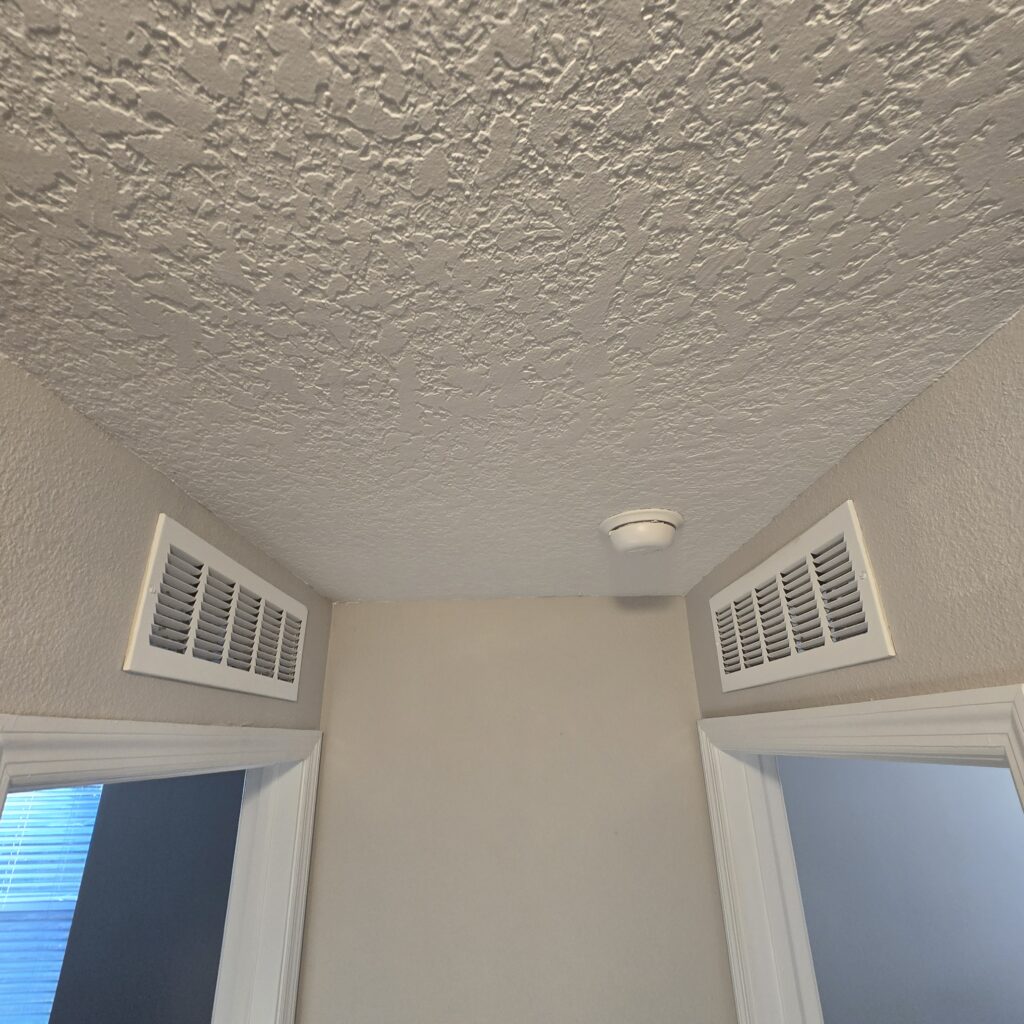
Supply side sealing follows the same process at every boot, takeoff, and plenum connection. Sealing the boot where the duct meets the ceiling drywall is particularly important, because that connection is often left open and allows attic air to enter right at the register. Homeowners sometimes see this as a dark halo of dust on the ceiling around the vent, which is attic air being pulled through the gap between the boot and the drywall. Correcting these connections restores proper pressure balance in the house and reduces infiltration through the building envelope. It also recovers cooling capacity that was previously being dumped into your attic. Most homes gain measurable efficiency from this work along with the improvement in cleanliness.
Duct cleaning has a place in this process, but the sequence matters. Cleaning ducts that still leak simply removes material that will be replaced within a few months, which is why we recommend sealing first and cleaning second. A proper cleaning uses negative pressure collection with agitation of the duct interior, not just a shop vacuum at the register. The blower wheel and evaporator coil should be cleaned at the same time, since a loaded blower wheel can lose a significant percentage of its airflow capacity and holds a remarkable amount of caked dust. Skipping the air handler components leaves the largest reservoir of dust in the system untouched. Ready to get the dust out of your system for good? Click here for our air conditioning services and we will inspect your ductwork, filtration, and airflow together.
How to Stop Dust on Your Vents With Regular System Maintenance
Consistent maintenance keeps the system from sliding back into the same condition. Twice yearly service in Central Florida is the practical standard given how many hours the equipment accumulates, with one visit before the heavy cooling season and one in the fall. During those visits a technician cleans the evaporator coil, checks the drain pan and condensate line, inspects the blower wheel, verifies refrigerant charge, and measures static pressure across the system. Static pressure readings above about 0.5 inches of water column on a typical residential system indicate an airflow restriction that will accelerate dust accumulation and shorten equipment life. Catching that early prevents a compounding problem where restricted airflow leads to a dirtier coil, which further restricts airflow. The maintenance visit is also when duct condition gets evaluated before small tears become large ones.
Coil cleanliness deserves particular attention in a humid climate. The evaporator coil runs wet through most of the year, and any dust that reaches it sticks to the fins and builds into a mat that blocks airflow and traps moisture. That combination creates ideal conditions for microbial growth, which produces odors and adds biological particulate to the air moving toward your registers. A dirty coil also raises operating pressures, reduces dehumidification, and increases the run time required to hit the thermostat setpoint. Cleaning the coil during routine service prevents this and protects the compressor from the strain of running against restricted airflow. Homeowners often notice both cleaner vents and better humidity control after a thorough coil cleaning.
Your part of the maintenance routine is straightforward and takes very little time. Check the filter monthly and replace it on a schedule that matches your actual conditions rather than the label. Keep supply registers and return grilles unblocked by furniture, rugs, and curtains so the system can move air the way it was designed to. Vacuum register grilles with a brush attachment rather than wiping them dry, which lifts the dust away instead of pushing it back into the duct. Keep the area around the outdoor condenser clear of grass clippings, mulch, and shrubs so the system does not have to work harder than necessary. These habits will not fix a leaking duct system, but they meaningfully extend the results of the work that does.
Why You Need a Professional to Stop Dust From Covering Your Vents
Dusty vents look like a cleaning problem and are almost always a mechanical one. Identifying the actual source requires testing airflow, measuring static pressure, inspecting duct runs in the attic, and evaluating how the house itself is pressurized. Those are diagnostic steps, not guesses, and they produce a repair plan built on measurements rather than assumptions. A trained technician can tell you within one visit if your problem is filter bypass, return leakage, a loaded blower wheel, humidity, or some combination of all four. That saves you from spending money on duct cleaning that will not hold or a filter upgrade that chokes your equipment.
What a Professional Dust and Air Quality Inspection Covers
A thorough inspection begins at the equipment and works outward through the distribution system. The technician measures total external static pressure, checks temperature split across the coil, inspects the blower wheel and coil surfaces, and verifies that the filter is sized and seated correctly. Those numbers reveal how the system is actually breathing compared to how the manufacturer designed it to breathe. Anything outside of specification points toward a specific cause rather than a general one.
From there the inspection moves into the attic and along the duct runs. Connections at the plenum, every takeoff, each flex run, and the boots at the ceiling all get checked for leakage, crushing, disconnection, and liner damage. Insulation condition matters too, since compressed or missing duct insulation causes condensation that leads to mold and material breakdown. A visual inspection of the interior of the ducts shows how much material has already accumulated.
The last piece is the house itself. Return grille placement, door undercuts, closed interior doors, and the tightness of the building envelope all affect how air moves and where dust enters. Homes with a single central return and closed bedroom doors often pressurize rooms in ways that pull outside air through the walls. Identifying those conditions leads to practical fixes like transfer grilles or additional returns. The result is a written plan you can act on rather than a vague recommendation.
What It Costs to Ignore Vents Covered in Dust
Ignoring dusty vents is expensive in ways that do not show up until later. Restricted airflow from a loaded filter, coil, or blower wheel forces the system to run longer to reach setpoint, which raises your electric bill every single month. That extra run time also adds wear to the compressor, the blower motor, and the contactor, shortening the useful life of equipment that costs thousands to replace.
Air quality consequences accumulate quietly. Circulating dust, dander, mold spores, and fiberglass fibers aggravate allergies and asthma, and Florida homes stay sealed with the air conditioner running for most of the year. Children and older adults tend to feel these effects first and most strongly. A duct system pulling attic air is effectively delivering unconditioned outdoor air into your bedrooms.
There is a moisture cost as well. Duct leakage and poor airflow reduce dehumidification, and sustained indoor humidity above 60 percent creates conditions for mold growth on drywall, in closets, and inside the air handler cabinet. Remediating mold is far more expensive than sealing ducts. Addressing the problem while it is still a dust complaint keeps it from becoming a moisture and health complaint.
Why Choose Legion Cooling to Stop Dust From Covering Your Vents
Legion Cooling is a family owned company operating out of Winter Garden, and we serve homeowners across Horizon West, Windermere, Clermont, Ocoee, Dr. Phillips, Celebration, and the surrounding communities. We are licensed and insured, and our technicians diagnose dust and air quality problems with instruments instead of assumptions. Every quote we provide is straightforward with no hidden fees, so you know the cost before any work begins.
Our approach is to fix the source of the problem and explain exactly what we found and why it matters. We will show you the static pressure readings, the condition of your blower wheel, and the duct connections that are leaking, and we will tell you plainly if a repair is not necessary. Financing is available for larger duct replacement and air quality projects, which keeps the right solution within reach.
We built this company on honest expert service and doing the job correctly the first time, every time. If your vents are covered in dust, we will find out why and give you a clear path to fixing it. Call Legion Cooling at (321) 316-2422 or email info@legioncooling.com to schedule your inspection.