
Most Common HVAC Issues and How We Fix Them
In the sweltering climate of Winter Garden, Florida, the air conditioner is less of an appliance and more of a survival tool. We run our systems harder and longer than almost anywhere else in the country, asking them to battle temperatures in the nineties and humidity that feels like a wet blanket for the better part of the year. Because of this relentless workload, mechanical failures are an unfortunate reality of homeownership in our region. When the cool air stops blowing, the immediate reaction is often one of panic, followed by the dread of an expensive repair bill. However, despite the complexity of modern HVAC systems, the vast majority of breakdowns we encounter at Legion Cooling fall into a few distinct categories.
Understanding these common failure points can demystify the repair process and lower your anxiety levels. It allows you to recognize the symptoms early—often before a catastrophic breakdown occurs—and gives you insight into what our technicians are doing when they arrive at your home. While some issues are simple fixes that take minutes, others are complex repairs involving high voltage electricity or high pressure refrigerants. Regardless of the severity, our approach is always rooted in accurate diagnosis and long term solutions, ensuring that we are not just putting a bandage on the problem but restoring the reliability of your home comfort system.
The Clogged Condensate Drain Line
By far the most frequent service call we receive in Central Florida involves water. An air conditioner does two things: it lowers temperature and it removes humidity. As the warm, moist air from your house passes over the cold evaporator coil, the moisture condenses into water droplets. In a typical summer day, your system can pull upwards of twenty gallons of water out of the air. This water drips into a pan and is carried away by a PVC pipe, usually exiting outside your home.
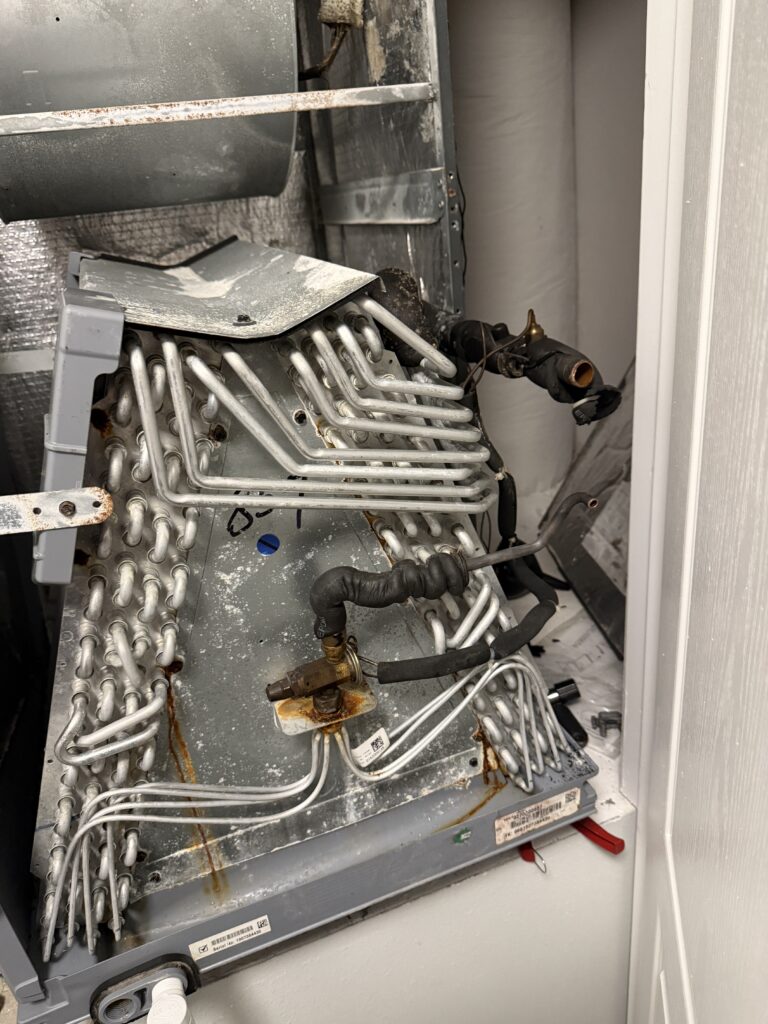
The problem arises because this drain line is a dark, wet environment—the perfect breeding ground for algae, mold, and bacterial slime. Over time, this biological growth creates a thick sludge that can block the pipe completely. When the water cannot drain, it backs up. If you are lucky, your system has a safety float switch that detects the rising water and shuts the unit off to prevent damage. If you are unlucky, or if the switch fails, the water overflows the pan and soaks into your ceiling, causing water stains, drywall damage, and potential mold issues in your home structure.
When we arrive to fix a clogged drain, we do not simply vacuum out the end of the pipe and leave. That is a temporary fix that will result in another clog in a few weeks. We perform a thorough flush of the entire drainage system. We use compressed nitrogen or a high powered vacuum to clear the physical blockage, ensuring the line is open from the unit to the exit point. We then treat the line with specialized cleaning agents that break down the remaining algae and inhibit future growth. We also test the operation of the float switch and inspect the pitch of the drain line to ensure gravity is doing its work effectively. Our goal is to ensure that the water your system removes leaves your home safely and consistently.
Capacitor Failure and Electrical Start Issues
If your outside unit is buzzing or humming but the fan is not spinning, you are likely dealing with a failed capacitor. The capacitor is a small, cylindrical electrical component that acts like a battery for the compressor and the fan motor. It stores a high voltage charge and releases it in a powerful burst to get the motors started. Once the motor is running, the capacitor allows it to cycle continuously.
Need an AC repair? Click here for our AC repair service.
In the intense heat of a Florida summer, capacitors are under immense stress. They are sensitive to overheating and voltage fluctuations. Because our systems cycle on and off frequently to maintain temperature, the capacitor is constantly being discharged and recharged. Eventually, the chemicals inside the capacitor break down, the casing swells, and it loses its ability to hold a charge. When this happens, the motors cannot start. The compressor might try to kick on, make a loud groaning noise, and then shut off on a safety thermal overload.
Fixing a capacitor is one of the more straightforward repairs we perform, but it is also one of the most dangerous for an untrained person to attempt. Even when the power to the unit is turned off, a capacitor can hold a lethal electrical charge. Our technicians begin by safely discharging the component to ensure it is safe to handle. We then use a multimeter to measure the microfarads, comparing the reading to the manufacturer’s rating. If the capacitor is weak or dead, we replace it with a high quality, American made component designed to withstand higher temperatures. We also inspect the motors to ensure the failed capacitor did not cause them to overheat or burn out, providing a complete check of the starting circuit.
Refrigerant Leaks and Coil Corrosion
A common misconception is that air conditioners “use up” refrigerant like a car uses gas. In reality, the refrigerant system is a closed loop. The chemical circulates endlessly, absorbing and releasing heat. If your system is low on refrigerant, it means there is a leak. In Winter Garden, leaks are frequently caused by a chemical reaction known as formicary corrosion. This occurs when volatile organic compounds in the air—from hairspray, cleaning products, or even building materials—react with the copper tubing of the evaporator coil and the moisture from condensation. This reaction creates microscopic pinholes in the copper, allowing the refrigerant to escape slowly.
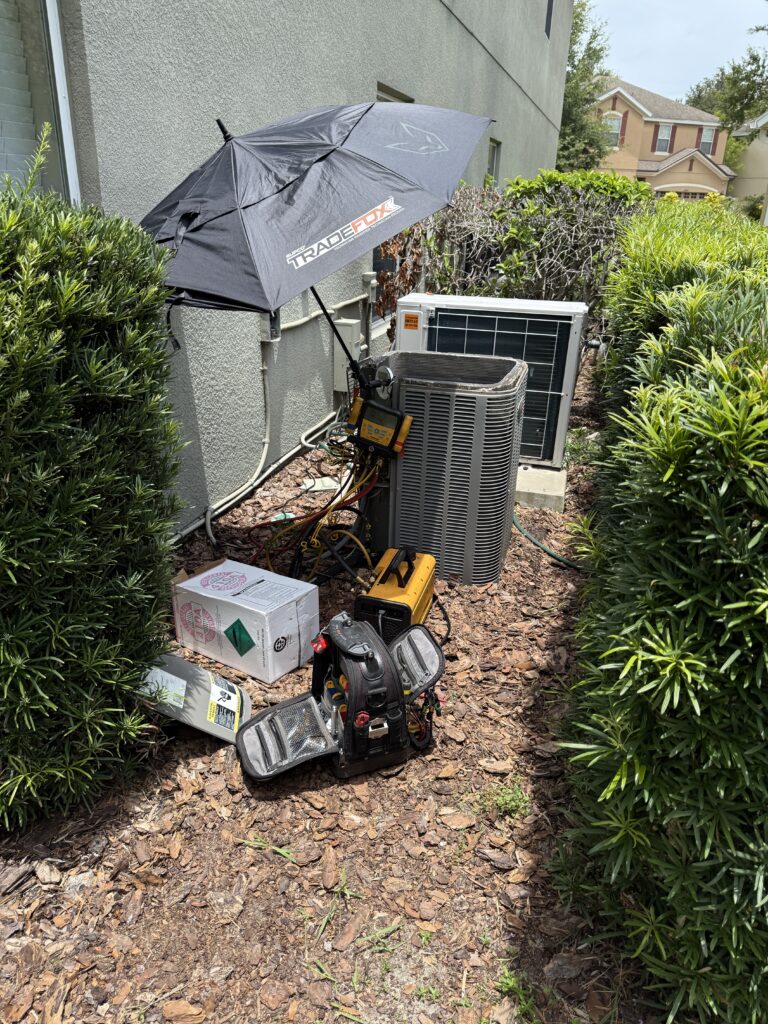
The symptoms of a leak are often a gradual loss of cooling power. You might notice the system running for hours without satisfying the thermostat. You might hear a hissing noise near the indoor unit, or see ice building up on the copper lines leading to the outside unit. Ice is a counterintuitive sign; it happens because the pressure in the system drops so low that the coil temperature falls below freezing, turning the condensation into a block of ice that blocks airflow.
Finding a refrigerant leak requires detective work. We use sophisticated electronic “sniffers” that detect the chemical presence of refrigerant in the air. We may also use UV dye, injecting it into the system and using a blacklight to find the glowing source of the leak. Once the leak is found, the repair strategy depends on the severity. If it is a loose fitting or a bad valve core, we can tighten or replace it. However, if the leak is in the fin pack of the evaporator coil, the hole is often too small and inaccessible to patch. In these cases, we often have to replace the entire coil or, depending on the age of the system, recommend a system replacement. We then recharge the system to the precise factory specifications, ensuring optimal pressure and cooling capacity.
Airflow Restrictions and Frozen Coils
Airflow is the lifeblood of an HVAC system. For the heat exchange process to work, a specific volume of air must move across the coils. When that airflow is restricted, the entire thermodynamic balance of the system collapses. The most common culprit is a dirty air filter. It is a simple thing, yet it causes a massive percentage of the service calls we run. When a filter is clogged with dust, pollen, and pet dander, the blower motor has to work overtime to pull air through it.
Want to know what your AC noise means? Click here for more information.
When airflow is choked off, the evaporator coil gets too cold because there is not enough warm air passing over it to keep the temperature up. As mentioned with leaks, this causes the moisture on the coil to freeze. We have arrived at homes where the indoor unit is encased in a solid block of ice, and the homeowner is confused because the fan is blowing but no air is coming out of the vents. Other causes of restriction can be collapsed ductwork in the attic, crushed by storage boxes or insulation, or a blower wheel that is so caked with dust that the blades cannot scoop air effectively.
Fixing an airflow issue often starts with a thawing process. We cannot work on a frozen system. Once the ice is melted, we inspect the filter and the ductwork. If the filter is dirty, we replace it and educate the homeowner on the proper MERV rating for their system. If the blower wheel is dirty, we pull the assembly and clean each blade to restore its aerodynamic efficiency. We also check the static pressure of the duct system to ensure the ducts are sized correctly for the unit. By restoring proper breathability to the system, we lower the strain on the motor and return the cooling performance to normal levels.
Thermostat Malfunctions and Control Failures
Sometimes the problem is not with the heavy machinery, but with the brain that controls it. The thermostat is the command center, sending low voltage signals to the relays and contactors that turn the components on and off. If the thermostat malfunctions, the system is essentially paralyzed. We often see issues where the thermostat screen is blank, the temperature reading is wildly inaccurate, or the system refuses to respond to changes in settings.
In many cases, this can be traced back to battery failure. If a thermostat relies on batteries and they die, the connection is broken. However, it can also be a wiring issue. The thin, low voltage wires that run through your walls can be chewed by pests, shorted out by a stray nail, or simply become loose at the terminal block over time. A short in the low voltage wiring can blow the fuse on the control board, shutting down the entire system to protect the transformer.
Our diagnostic process involves tracing the electrical path from the thermostat to the air handler and out to the condenser. We use multimeters to check for continuity and proper voltage at each connection point. If the thermostat is outdated or broken, we replace it, often upgrading the customer to a modern, digital, or smart thermostat that offers better control and efficiency. We ensure the new device is calibrated correctly to read the true room temperature and that it is configured to manage the specific staging of the homeowner’s heat pump or straight cool system.
While the mechanics of an air conditioning system are complex, the issues that plague them are often predictable. From the biological sludge clogging a drain line to the microscopic corrosion eating away at a copper coil, the Florida environment is a harsh testing ground for HVAC equipment. Recognizing the signs of these common failures—the water spots, the buzzing noises, the ice, and the loss of cooling—empowers you to act quickly.
At Legion Cooling, we believe that a proper repair is one that addresses the root cause, not just the symptom. We do not just add refrigerant; we look for the leak. We do not just unstick a motor; we check the capacitor that powers it. By understanding how we fix these common issues, you can have confidence that when you call us, you are getting a solution that stands the test of time and returns your home to the cool, comfortable sanctuary you expect.