
Why Fall Is the Best Time for an HVAC Tune Up
Fall in Central Florida does not show up with frost on the windshield, but it does bring the first real break your air conditioner has had since April, and that break is exactly what makes this season so valuable for maintenance. After five or six straight months of running through afternoon highs in the nineties and humidity that rarely drops below sixty percent, your system has accumulated wear that never showed up as a breakdown, and most of it is still sitting there waiting for the next heavy load. October and November give a technician the room to slow down, open the equipment, measure what is actually happening inside it, and correct small problems while the house can still stay comfortable without the system running constantly. A fall HVAC tune up also lands right before the handful of cool nights when Central Florida homeowners finally call for heat, and that first heating cycle is when neglected heat pumps and electric heat strips tend to announce their problems. Homeowners in Winter Garden, Horizon West, Windermere, Ocoee, and Clermont deal with a cooling season that stretches roughly nine months, so the short shoulder season carries more weight here than it does further north. Scheduling now also means shorter wait times, more appointment flexibility, and repair decisions made calmly instead of in the middle of a July emergency. The rest of this article explains what makes the fall window different, what a real tune up covers, and how to get yours on the calendar before the season fills up.
What Makes Fall the Best Time for an HVAC Tune Up in Central Florida
The value of a fall HVAC tune up comes down to timing, load, and access. During summer your system runs nearly around the clock, which means a technician cannot safely shut it down for long, cannot let coils dry for a proper cleaning, and cannot take accurate readings on a machine that has not had a chance to stabilize. Fall changes all three of those conditions at once. Outdoor temperatures drop into a range where the system cycles normally instead of running continuously, and that gives a technician the ability to test performance at startup, at steady state, and at shutdown. Fall is also the last quiet stretch before the short Central Florida heating season, which for most homes means a heat pump reversing into heating mode for the first time in months. Catching a weak capacitor, a restricted drain line, or a low refrigerant charge in October is a scheduled repair; catching the same problem in January or in the first heat wave of spring is an emergency call.
How Fall Weather Sets Up the Ideal HVAC Tune Up Window
Mild fall weather changes what a technician can actually accomplish during an HVAC tune up, and that difference matters more than most homeowners expect. When outdoor temperatures sit in the eighties instead of the mid nineties, the system reaches steady operating conditions faster and holds them longer, which produces refrigerant pressure and temperature readings that reflect real performance rather than a machine fighting extreme load. A technician can shut the unit down for twenty or thirty minutes to pull the blower wheel, clean an evaporator coil properly, or inspect a compressor terminal without leaving the house uncomfortable. Coil cleaning in particular benefits from this window, because a coil that is rinsed and allowed to dry cleans far better than one that goes straight back under a heavy cooling load. Access to the equipment is also easier in fall, since attic air handlers in Central Florida homes routinely hit well over one hundred and twenty degrees in August, and heat that severe limits how long anyone can work safely. The result is a more thorough visit with better measurements and fewer shortcuts.
Lower load also reveals problems that summer masks. A system that is slightly undercharged, running with a dirty condenser coil, or moving less air than it should will often still cool a house in October, and that is precisely why fall testing is so useful. Instead of a homeowner discovering the issue when the house climbs to eighty two degrees on a July afternoon, the technician finds it through measurements such as temperature split across the coil, static pressure in the duct system, and amp draw on the compressor and blower motor. Those numbers tell a clear story about system health even when comfort feels acceptable. A unit that is quietly working harder than designed is burning extra electricity every single cycle, and that cost adds up across a Florida cooling season that never really ends. Correcting it in the fall protects both the equipment and the utility bill for the following year.
There is a scheduling advantage as well, and it is a practical one. Summer and the first hot week of spring generate the heaviest call volume of the year for every HVAC company in Central Florida, which pushes maintenance appointments behind emergency repairs. Fall opens up the calendar, so homeowners get their preferred day, a longer appointment window, and a technician who is not racing to the next no cooling call. Parts availability follows the same pattern, since a compressor, blower motor, or control board ordered in October arrives without competing against peak season demand. If the tune up uncovers something that needs replacement, you have time to compare options, review financing, and make a decision based on value rather than urgency. That calm decision making is one of the most underrated benefits of fall maintenance. Need a professional set of eyes on your system before the season turns? Click here for our air conditioning service.
Why a Fall HVAC Tune Up Catches Summer Wear Before It Spreads
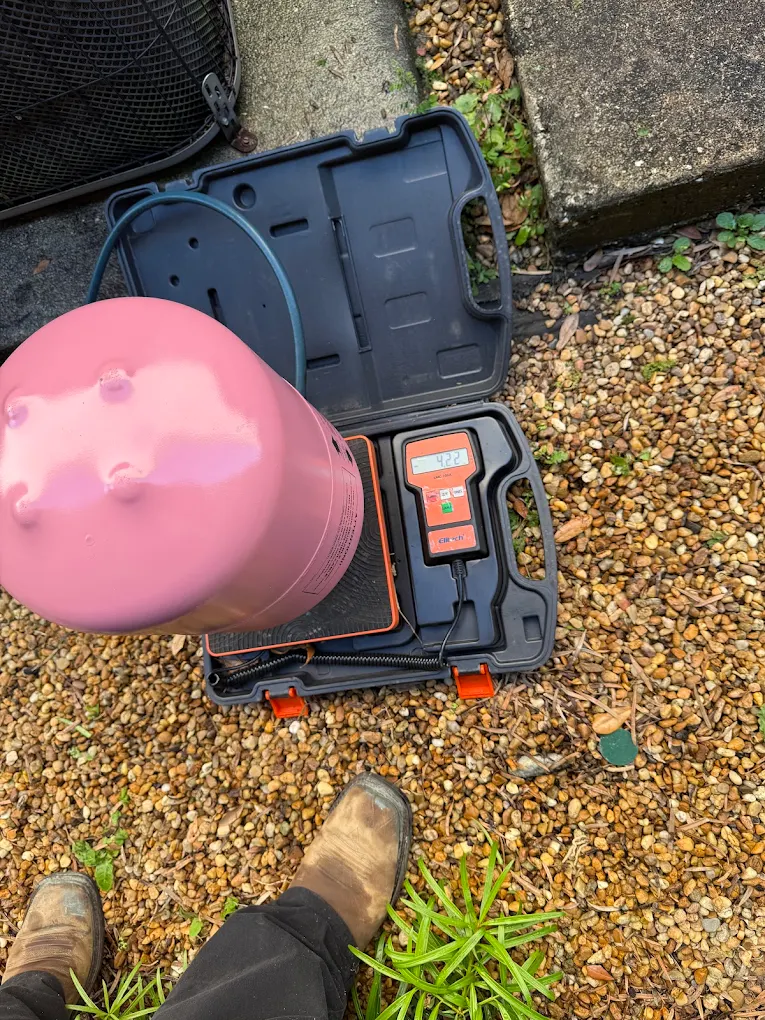
Central Florida air conditioners work harder than equipment almost anywhere else in the country, and a fall HVAC tune up exists specifically to address that accumulated wear. A typical system in Winter Garden or Horizon West runs several thousand hours between March and September, and every one of those hours puts stress on the compressor, the contactor, the run capacitor, the blower motor bearings, and the condensate management system. Capacitors are the clearest example, because they degrade with heat exposure and lose microfarad capacity gradually rather than failing all at once. A capacitor rated at forty five microfarads that measures thirty eight still starts the compressor, but it draws higher amperage doing it, and that extra current shortens compressor life. Testing capacitance in the fall identifies that decline while it is still a fifteen minute part swap. Ignoring it usually means a hard start failure on the hottest day of the following summer, with a much larger repair attached to it.
Contactors and electrical connections tell a similar story. The contactor is an electromechanical switch that closes every time the outdoor unit starts, and after a full Florida cooling season its contact surfaces can show pitting, burning, or carbon buildup from arcing. A pitted contactor causes voltage drop, which makes the compressor run hotter and less efficiently, and in some cases it welds shut and leaves the outdoor unit running continuously. Wire terminals loosen from thermal cycling as metal expands and contracts thousands of times, and a loose connection generates heat that can eventually damage a control board or burn a wire completely. During a fall tune up a technician tightens connections to specification, inspects for discoloration, and measures voltage drop across the contactor while the system runs. These are small corrections with outsized consequences.
Condenser coils carry the last piece of summer wear, and in this part of Florida they take real abuse. Grass clippings, pollen, oak debris, dryer lint, and construction dust from the constant development around Horizon West and Clermont all collect in the outdoor coil fins across a long cooling season. A coil coated in that debris cannot reject heat efficiently, which raises head pressure, increases compressor amp draw, and lowers cooling capacity while raising the electric bill. Homeowners rarely notice the change because it happens gradually over months. A proper fall cleaning with the correct coil cleaner and a controlled rinse restores heat transfer and drops operating pressures back into design range. That single step often produces the most measurable efficiency improvement of the entire visit.
How a Fall HVAC Tune Up Prepares Your System for Cool Nights
Central Florida heating is short, but it is real, and it catches a surprising number of homeowners off guard every year. Most homes in Winter Garden and the surrounding communities use a heat pump, which is the same outdoor unit that cooled the house all summer running in reverse to move heat indoors. That reversal depends on a reversing valve, a solenoid coil, and a defrost control board, none of which have operated since the previous winter. A component that sits idle for nine months can stick, corrode, or fail to energize, and the failure only shows up when you actually call for heat. A fall HVAC tune up puts the system into heating mode intentionally, verifies that the reversing valve shifts, and confirms that supply air temperature rises as designed. Finding a stuck valve in November is far better than finding it during the first cold snap in January.
Auxiliary and emergency heat deserve the same attention. Heat pumps in this region are paired with electric resistance heat strips in the air handler, and those strips provide backup when outdoor temperatures fall or when the system runs in defrost. Heat strips draw substantial amperage, often thirty to sixty amps depending on the kilowatt rating, and they rely on sequencers, limit switches, and fuses that need to function correctly for safe operation. Dust and debris settle on unused strips over a long summer, which produces a burning odor the first time they energize and occasionally trips a limit. A technician energizes each stage, measures amp draw against the nameplate rating, and verifies that safety controls operate. That test also confirms the strips are not staging on unnecessarily during mild weather, which is one of the fastest ways to spike a December electric bill.
Thermostat configuration is the final piece of heating readiness, and it is frequently the culprit behind winter complaints. A thermostat has to be wired and programmed correctly for heat pump operation, including proper reversing valve orientation on the O or B terminal and appropriate settings for auxiliary heat lockout and staging. A thermostat set up as a conventional furnace system will command the equipment incorrectly, which can leave the house cool, run expensive backup heat constantly, or both. Smart thermostats add another layer, since aggressive recovery settings can call auxiliary heat when the heat pump alone would have handled the load. During a fall tune up a technician confirms terminal assignments, tests each mode, and adjusts differential and staging settings for the way your household actually uses the system. Curious what your heat pump should be doing when the temperature drops? Click here for our heat pump service.
What a Complete Fall HVAC Tune Up Includes
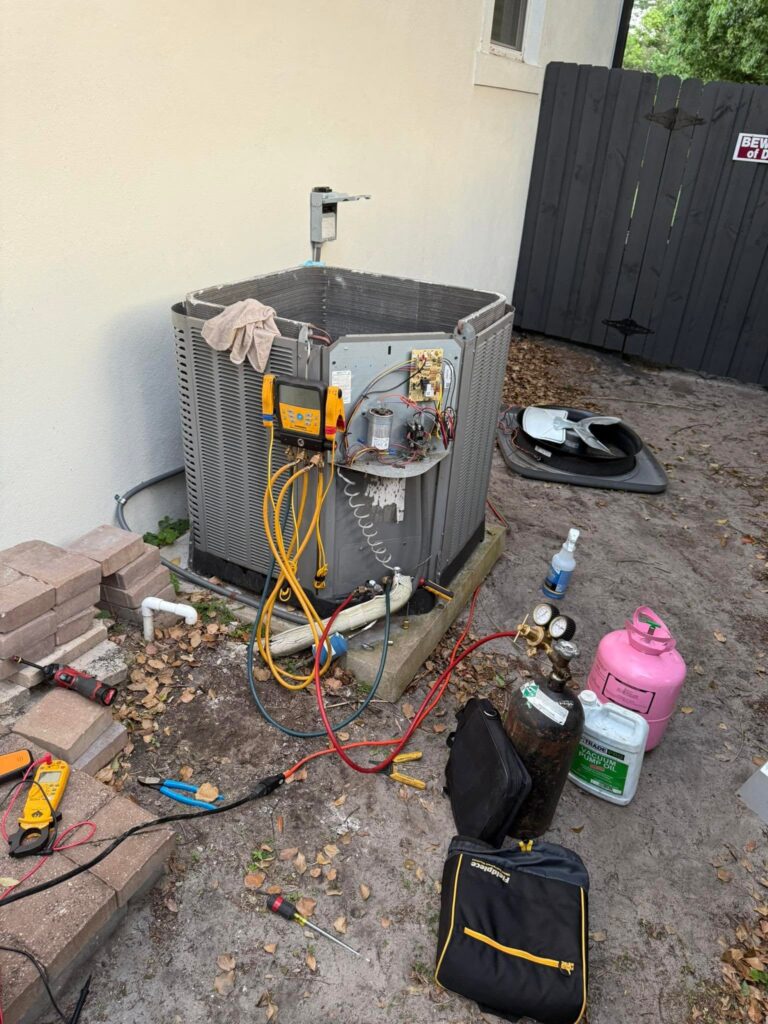
A fall HVAC tune up should be a measured inspection, not a quick visual walk around with a filter change. The difference between the two shows up in the readings a technician records and the corrections made based on those numbers. A complete visit covers the electrical system, the airflow path, the condensate system, the refrigerant circuit, and the heating components, and it ends with a clear explanation of what was found. Legion Cooling technicians document capacitance values, amp draw, voltage, temperature split, static pressure, and refrigerant pressures so homeowners can see how the equipment is actually performing rather than taking a verbal assurance. Manufacturer warranties on most residential systems also require documented annual maintenance, and a missing service history can complicate a compressor or coil claim years later. The sections below break the visit into the three areas that matter most for Central Florida homes.
The Electrical Checks in a Fall HVAC Tune Up
Electrical testing is the foundation of any serious HVAC tune up, because the majority of no cooling and no heating calls trace back to an electrical component rather than the compressor itself. The technician starts by verifying incoming voltage at the disconnect and at the unit, since low or unbalanced voltage stresses motors and shortens their life considerably. Run capacitors are tested with a meter and compared against the rated microfarad value printed on the case, with most manufacturers considering anything more than six percent below rating to be out of tolerance. Compressor and condenser fan motor amp draw are measured against the rated load amps on the data plate, and a reading that trends high points toward mechanical wear, a dirty coil, or a failing bearing. Contactors are inspected for pitting and tested for voltage drop across the contacts. Every accessible terminal and lug is checked for tightness, since thermal cycling loosens connections over a long Florida season.
Control circuits get the same scrutiny. The low voltage side of the system includes the transformer, the thermostat wiring, the safety switches, and on many systems a control board that manages timing and staging. A twenty four volt transformer that reads low, a float switch with corroded terminals, or a chafed thermostat wire running through an attic can all create intermittent faults that are maddening to diagnose during an emergency call but simple to catch during a scheduled inspection. Technicians also verify that the condensate safety switch actually interrupts the circuit when triggered, because a switch that has failed open or been bypassed removes the only protection against water damage from a clogged drain. Surge protection is worth evaluating too, given how frequently Central Florida takes lightning strikes and utility disturbances. A single surge event can destroy an inverter driven system’s control board, and modern variable speed equipment carries expensive electronics.
Grounding and safety verification round out the electrical portion. Proper equipment grounding protects both the homeowner and the control electronics, and technicians confirm that the ground path is intact at the unit and the disconnect. Breaker and fuse sizing is compared against the maximum overcurrent protection listed on the data plate, since an oversized breaker installed during a past repair removes a designed layer of protection. Wire gauge is checked against the minimum circuit ampacity for the same reason. On heat pump systems the technician also verifies that the heat strip fusing is correct and intact, because a blown strip fuse is a common reason a home has cool air coming from the vents on a January morning. These checks take time, but they prevent the failures that leave families without conditioned air.
The Airflow and Drainage Steps in a Fall HVAC Tune Up
Airflow determines how well every other component performs, so a fall HVAC tune up spends real time on the air path. The technician measures total external static pressure across the air handler with a manometer and compares it to the maximum rating for the equipment, which is commonly around 0.5 inches of water column on residential systems. High static pressure means the blower is fighting the duct system, and that condition reduces capacity, raises energy use, increases noise, and shortens motor life. Common causes include undersized return ducts, crushed or kinked flexible duct, closed supply registers, restrictive filters, and dirty coils. Blower wheels are inspected for dust buildup, since a coated wheel loses a significant percentage of its air moving capability without any obvious symptom. Evaporator coils are checked for debris and biological growth on the entering air side, which is where restriction actually forms.
Filtration gets attention next, and the goal is balance rather than the highest possible rating. A filter that is too restrictive for the duct system raises static pressure and starves the coil for air, which can lead to freezing in cooling mode and poor performance overall. Most Central Florida homes do well with a filter in the MERV 8 to MERV 11 range replaced every one to three months, though households with pets, allergies, or nearby construction may need a shorter interval. Filter fit matters as much as rating, because air bypassing a loose filter carries dust straight onto the evaporator coil. Technicians confirm the filter size, check the housing seal, and explain the replacement schedule that fits the home. Duct leakage is evaluated too, since supply leaks in a hot attic waste conditioned air and return leaks pull in dusty, humid attic air that lands on the coil.
Condensate management is the step Central Florida homeowners cannot afford to skip. Air conditioners remove a substantial amount of moisture from indoor air during our long humid season, and all of that water leaves through a drain line that runs to the exterior or to a plumbing connection. Biological growth thrives in that warm, wet environment and forms slime that gradually blocks the line, and a blocked line either trips the float switch and shuts the system down or overflows into a ceiling. During a fall tune up the technician clears the primary drain, verifies flow, checks the trap, inspects the secondary pan and its float switch, and confirms the drain slope is adequate. Pan tablets or treatment can be added to slow regrowth through the following season. Water damage from a clogged drain line is one of the most expensive and most preventable HVAC failures in Florida homes. Concerned about dust, humidity, or air quality in your home? Click here for our indoor air quality service.
The Refrigerant and Heating Checks in a Fall HVAC Tune Up
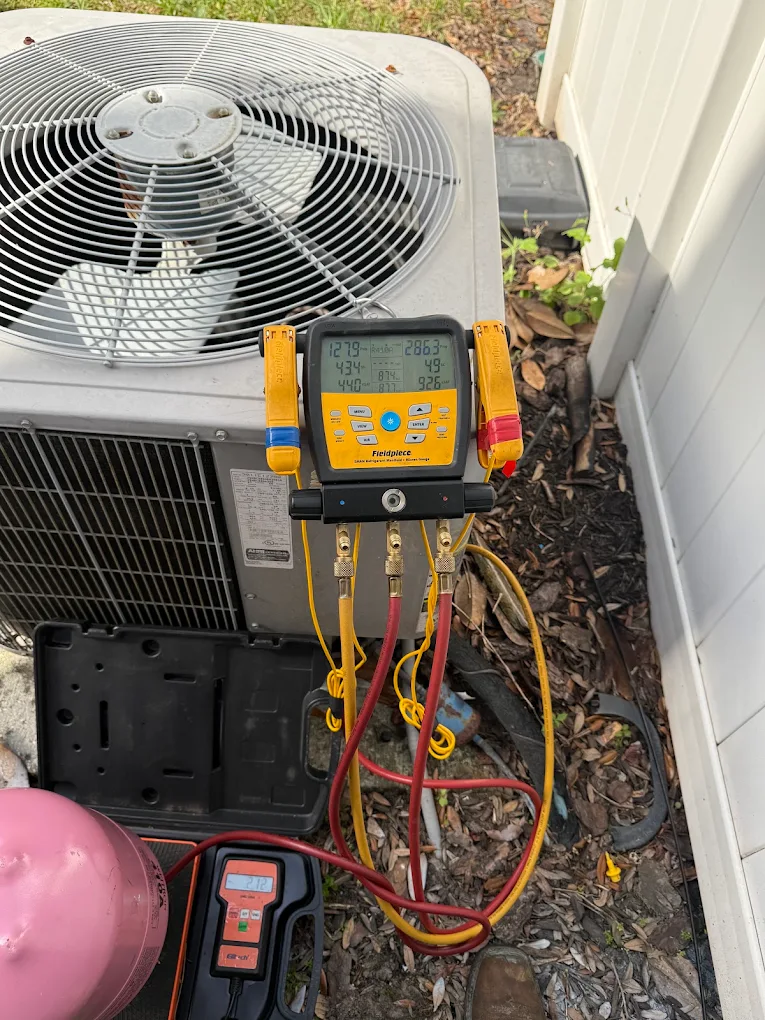
Refrigerant verification is where a technician confirms that the heart of the system is doing its job. Charge is evaluated using superheat on fixed orifice systems and subcooling on systems with a thermostatic or electronic expansion valve, with target values based on manufacturer specifications and current operating conditions. A system running low on charge loses capacity, runs longer cycles, and risks compressor damage from poor motor cooling and oil return. Because refrigerant is a sealed system component, low charge always means a leak somewhere, and adding refrigerant without finding the leak simply postpones the problem. Technicians use electronic leak detection, bubble solution, or ultraviolet dye depending on the situation, and common leak points include evaporator coil tubing, service valves, brazed joints, and line set connections. Repairing a leak properly protects both the equipment and the homeowner’s wallet.
Refrigerant type matters more now than it did a few years ago, and homeowners should understand what is in their system. Older equipment installed before roughly 2010 may still use R22, which is no longer produced or imported in the United States and has become extremely expensive to source. Systems from the last fifteen years typically use R410A, and new residential equipment manufactured beginning in 2025 uses lower global warming potential refrigerants such as R454B under the AIM Act phase down. This affects repair economics directly, since a significant leak in an aging R22 system usually favors replacement over repair. A fall tune up is the right time to have that conversation, because you can evaluate options and financing without a broken system forcing the timeline. Legion Cooling technicians explain what your equipment uses and what the realistic path forward looks like.
Heating verification closes out the tune up for Central Florida systems. On a heat pump the technician commands heating mode, confirms the reversing valve shifts cleanly, measures supply and return air temperatures, and checks that the defrost control initiates and terminates correctly. Outdoor coil condition matters in heating mode too, since the outdoor coil becomes the evaporator and a dirty coil hurts heating capacity the same way it hurts cooling. On the small number of homes with a gas furnace, the technician inspects the heat exchanger for cracks, verifies burner ignition and flame quality, checks the flue and venting for obstruction or corrosion, and confirms the safety controls operate. Carbon monoxide testing is part of any gas appliance inspection and should never be skipped. Electric heat strips are staged and amp tested, and the technician confirms the system does not call for backup heat unnecessarily during mild conditions.
Why You Need a Fall HVAC Tune Up From Legion Cooling
A tune up is only as valuable as the technician performing it, and that is where the difference between a checklist visit and real service becomes obvious. Legion Cooling approaches maintenance as diagnostic work, with measurements recorded, findings explained in plain language, and recommendations presented honestly rather than upsold. We serve Winter Garden, Horizon West, Windermere, Ocoee, Clermont, Dr Phillips, Apopka, Winter Park, and the surrounding Central Florida communities, so we know exactly what nine months of cooling load does to residential equipment here. Every quote we provide is straightforward with no hidden fees, and financing is available when a repair or replacement makes more sense than continuing to patch aging equipment. Booking your fall HVAC tune up now means shorter waits, better appointment options, and a system ready for both the cool nights ahead and the long season that follows.
What You Save With a Fall HVAC Tune Up
The financial case for a fall HVAC tune up rests on three things: energy use, repair costs, and equipment lifespan. A system with clean coils, correct charge, proper airflow, and tight electrical connections uses meaningfully less electricity than one running with any of those issues, and in a climate where cooling runs most of the year that gap compounds every month. Preventing a single compressor failure pays for many years of maintenance, since compressor replacement is one of the largest repair expenses in residential HVAC. Manufacturer warranties on compressors and coils frequently require proof of annual professional maintenance, and homeowners without that documentation sometimes discover the requirement at the worst possible moment.
Lifespan is the second and larger saving. A well maintained heat pump in Central Florida commonly reaches twelve to fifteen years of service, while a neglected system running with a dirty coil, weak capacitor, and restricted airflow can fail years earlier. Every year of additional service life delays a four or five figure replacement expense. Maintenance also preserves capacity, meaning the system continues to cool and dehumidify the way it did when it was installed rather than slowly losing ground. Homeowners who skip maintenance rarely notice that decline until comfort becomes a complaint.
The third saving is the emergency premium you never pay. Repairs made during a scheduled fall visit happen on your timeline with normal parts availability and normal scheduling. Failures during a July heat wave mean urgent calls, longer waits, and comfort problems in a house that heats up quickly. Small corrections made early stay small, while ignored problems cascade into related component damage. That predictability is the practical reason maintenance pays for itself.
How to Schedule Your Fall HVAC Tune Up
Scheduling a fall HVAC tune up with Legion Cooling is simple, and the earlier in the season you call, the more flexibility you have. Reach our team at (321) 316 2422 or send a message to info@legioncooling.com, and we will find an appointment window that works around your day. Homes with older equipment, recent comfort complaints, or a history of drain line issues should get on the calendar first. Rental properties and second homes benefit from fall service as well, since problems in an unoccupied house go unnoticed until damage occurs.
Before the technician arrives, a few small steps make the visit more productive. Clear a working path to the indoor air handler and remove stored items around the outdoor unit so there is room to open panels and access components. Make a short list of anything you have noticed, including uneven room temperatures, unusual noises, humidity that feels high, longer run times, or a rising electric bill. Those observations often point a technician toward findings that a standard inspection might not surface.
Households with multiple systems, a mini split serving a garage or addition, or a business location should mention that when scheduling so we allocate the right amount of time. Legion Cooling handles both residential and commercial equipment across the Central Florida service area. We will also review your filter type and replacement schedule during the visit and explain anything we recommend before performing additional work. Ready to get your system on the schedule? Click here to see all of our HVAC services.
Why Choose Legion Cooling for Your Fall HVAC Tune Up
Legion Cooling is a family owned and faith driven company built on honest, expert service, and that shows up in how we handle maintenance. We do not use tune ups as a sales opportunity, and our technicians explain findings with the actual measurements behind them so you understand the condition of your equipment. When a component tests within specification, we tell you it is fine. When something needs attention, we show you why and give you options.
Licensing and insurance protect you, and we carry both. Our technicians work on the full range of equipment found in Central Florida homes, including heat pumps, straight cool systems with electric heat, gas furnaces, ductless mini splits, and commercial rooftop units. We are local, which means we understand the specific demands that heat, humidity, storms, and construction dust place on systems in Winter Garden, Horizon West, Clermont, and the surrounding communities.
Straightforward quotes with no hidden fees have been our standard since day one, and financing is available when equipment reaches the end of its useful life. We are committed to getting it done right every time, on the first visit, with workmanship you can rely on. Call (321) 316 2422 to book your fall HVAC tune up and head into the season with a system you can trust.